
Here’s a question that might make you uncomfortable: What if most of your leadership development budget is being wasted?
Think about it. Your organization probably spends thousands (maybe hundreds of thousands) on leadership development every year.
Executive coaching. Leadership retreats. Skills workshops. All valuable concepts, but here’s what we keep seeing: six months later, organizational performance hasn’t meaningfully shifted.
The uncomfortable truth? Most leadership initiatives build awareness or spark inspiration around a leadership concept or trending topic. But that’s not why you invest in leadership development.
You invest because you need results. You need strategy to actually turn into execution and business outcomes. You need teams that deliver consistently, not just when everything goes perfectly.
Which means leadership development has to do one thing: build the capability that fuels organizational performance.
Back to Basics: Why Do We Invest in Leadership?
Let’s cut through the noise and get real about what you’re actually trying to achieve.
The purpose of leadership isn’t to look polished in a meeting or to feel inspired at a retreat (though those might be nice side effects). The purpose is simple: turn strategy into results.
Which means leadership development has to do one thing:
Build the capability that fuels organizational performance.
Here’s how we think about it:
- Leadership Capability = The Engine. When leaders at every level have the clarity, habits, and skills they need, the organization has the horsepower to actually move strategy forward.
- Organizational Performance = What the engine drives. It’s the day-to-day execution — the ability to connect priorities, align teams, and consistently deliver on commitments.
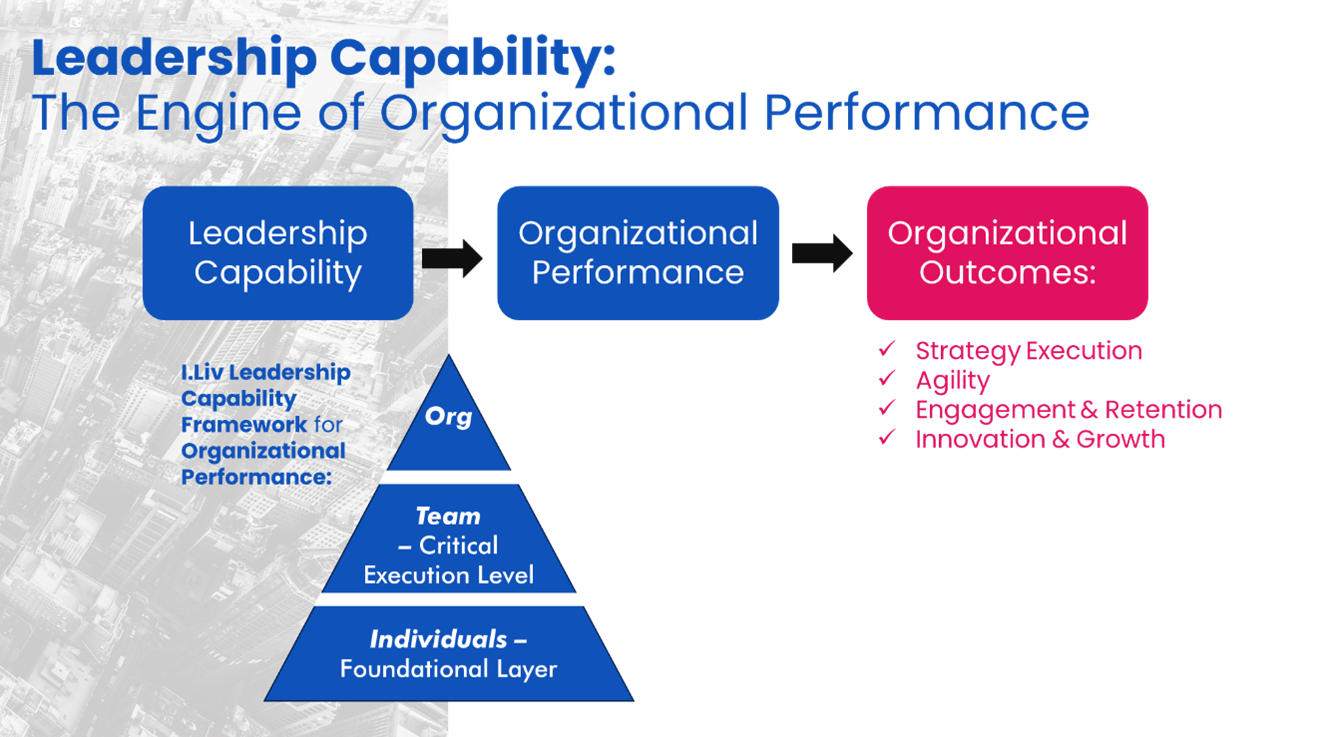
- Organizational Outcomes = Where it takes you. Reliable execution, agility, retention and engagement, innovation. These aren’t abstract ideas; they’re the measurable results that determine whether your organization grows, adapts, and competes.
And here’s the part that might surprise you:
👉 For org-wide performance, leadership capability cannot be reserved for a select few at the top, or for hand-picked “high potentials.”
If performance is an organizational outcome, then leadership capability has to be an organizational capability. You need org-wide leadership capability for org-wide performance.
That’s exactly what we’ve captured in the I.Liv Leadership Capability Framework – a practical model for what success looks like: leadership capability that drives reliable, resilient and sustainable organizational performance.
The I.Liv Leadership Capability Framework
So, what does org-wide leadership capability look like in practice?
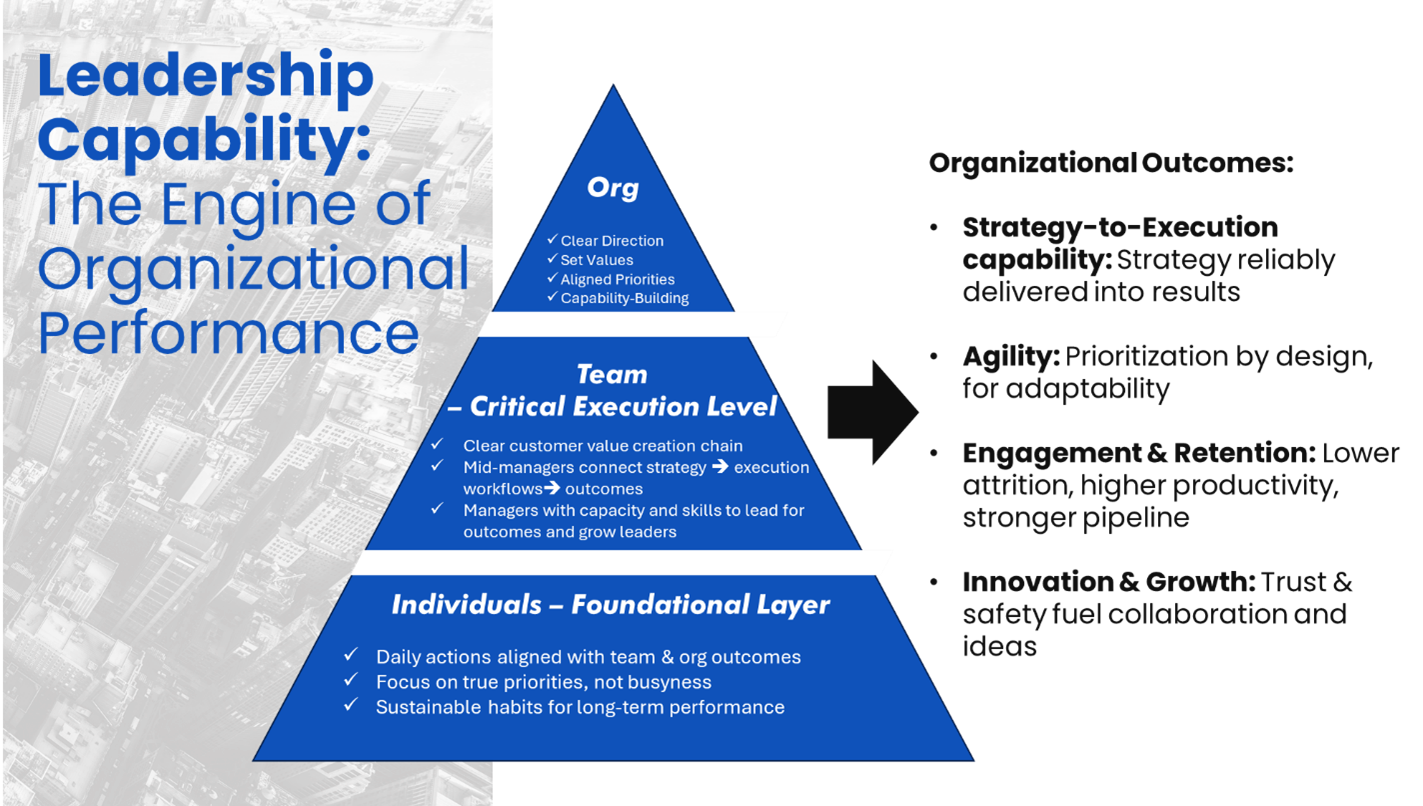
We break it down into three interconnected levels. Performance only scales when all three are strong. Miss one and the whole system wobbles.
1. Organizational Level – Alignment and Direction. Performance starts with clarity at the top. Without alignment, even the most talented individuals and teams pull in different directions. With it, the entire organization channels its energy into outcomes that matter.
This looks like:
- Set Vision and Values
- Clear direction that cuts through noise.
- Priorities that align across business units.
- Ongoing capability-building to ensure the system grows with the business.
2. Team Level – Strategy Execution in Action. The middle management layer is where strategy lives or dies. When this layer is weak, strategy stalls in translation. But when teams become true execution engines, the organization gains consistency, focus, and momentum.
- Clear customer value creation chain
- Workflows must connect the ‘big picture’ to daily execution.
- Managers need the capacity and skills to lead for outcomes and grow leaders.
3. At the Individual Level – Daily Focus and Habits. At the foundation, performance lives in the everyday actions of individuals (at every level). People who work with clarity and resilience don’t just succeed individually – they create stability for their teams and momentum for the organization. Without this base, everything above eventually wobbles.
This means:
- Daily clarity keeps people focused on priorities, not just busyness.
- Sustainable habits enable leaders to perform sustainably
When all the levels are strong, performance is not accidental — it’s consistent, resilient, and scalable.
How to Put the Framework into Action
A framework only matters it drives actual value. Here’s how organizations can use it to move beyond theory into measurable impact:
- Assess Your Current Maturity. Map your existing leadership programs, investments, and culture against the framework. This kind of maturity assessment reveals whether your efforts are building capability that sustains performance — or whether they’re fragmented, reactive, and leaving gaps.
Ask yourself:
- At the organizational level: Are priorities aligned, or is execution left to chance?
- At the team level: Are managers translating strategy into action, or drowning in demands?
- At the individual level: Are people building clarity and sustainable habits, or stuck in cycles of busyness and burnout?
- Chart the Way Forward with Clear Criteria for Success. Once you see the current state clearly, the framework becomes a guide to what’s needed next. These criteria like these help leaders, HR, and L&D teams make sharper choices about where to invest and how to sustain leadership capability as a driver of continuous organizational performance.
- Does your organization have a system for developing leaders at every level, not just the top?
- Are you measuring leadership development in terms of outcomes — execution, agility, retention, innovation — instead of attendance or satisfaction?
- Do your investments build sustainable capability, or are they temporary boosts that fade after the workshop ends?
- Plan and Measure ROI
Leadership development isn’t about activity – it’s about business outcomes. To prove impact, organizations need to connect every dollar spent to measurable performance gains.
✔ Map the flow: Investment → Action → Results.
✔ Define the metrics that matter in terms of real business outcomes that matter most: strategy execution, agility, retention & engagement, and innovation & growth
✔ Scale matters: if development only touches a handful of people in a workshop, you can’t expect organization-wide, sustained results.
When leadership capability is treated as a system rather than a series of events, ROI becomes visible – not in attendance sheets, but in performance data that executives care about.
Ready to See What This Looks Like in Practice?
The real differentiator isn’t whether you invest in leadership – everyone does. It’s whether you connect leadership capability directly to organizational performance, in how you measure it and how you develop and sustain it.
Leadership development doesn’t have to be a leap of faith. When done right, it becomes one of your most measurable investments.
Join our upcoming webinar where we’ll share:
- The I.Liv Leadership Capability Framework and how to apply it
- The 3 key ways most organizations get leadership development wrong (and how to avoid these costly mistakes)
- A clear roadmap forward, including practical tools to get started:
- ROI Calculator to quantify the true cost in business terms
- Maturity Assessment to evaluate leadership health
- Clear Criteria for smarter investment decisions
Because leadership shouldn’t just inspire the few — it should deliver results through the many.